
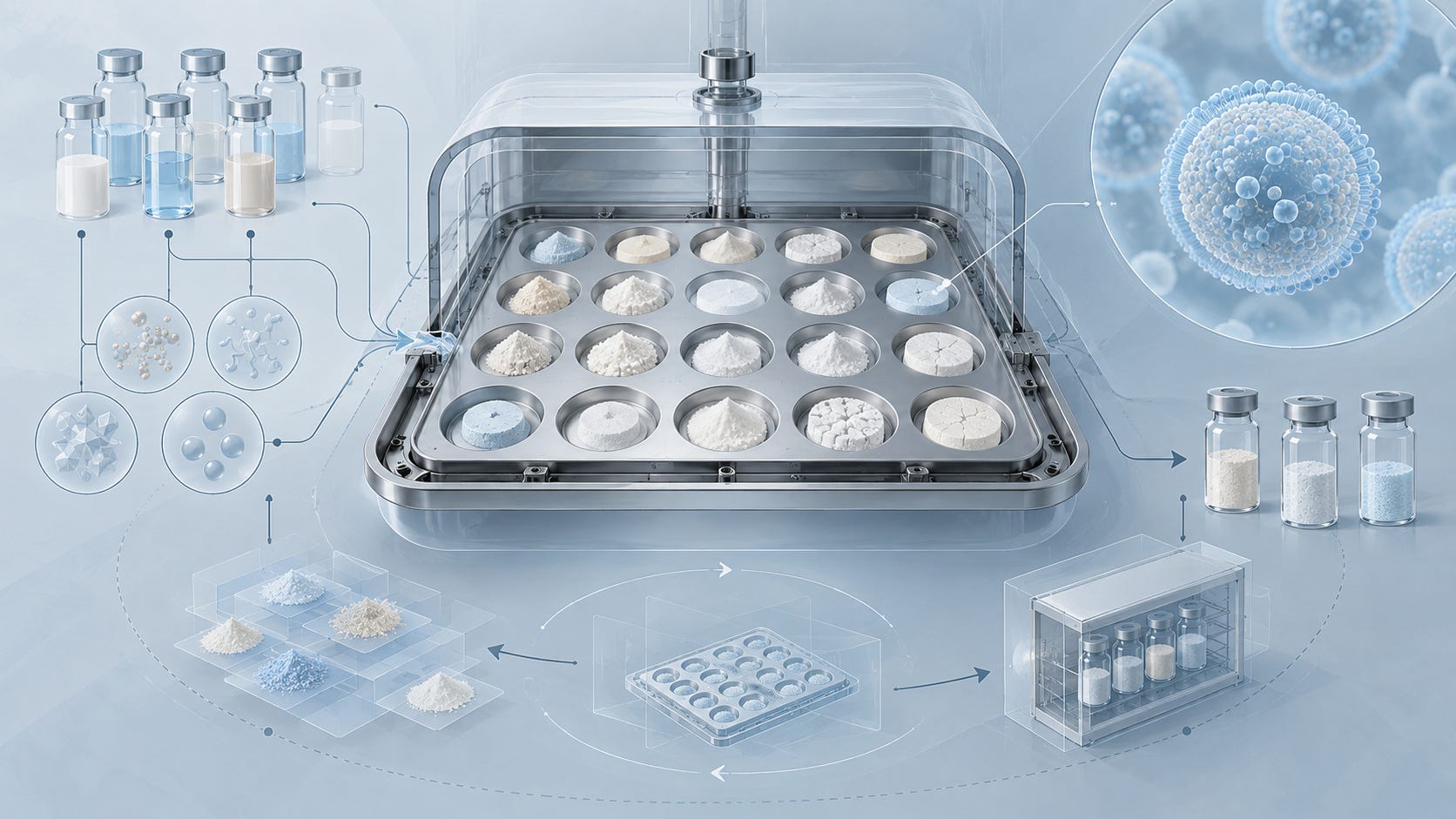
Figure 1. Conceptual blueprint of excipient candidates progressing through vacuum drying and storage testing of solid-state mRNA–LNP formulations. Arrows are illustrative, not measured data.
The cold chain is not merely a shipping inconvenience for an mRNA vaccine. It is a visible consequence of a coupled stability problem: the RNA and the lipid particle that carries it can lose function in different ways. A team led by MIT researchers has now reported a data-efficient route to solid-state mRNA–lipid nanoparticle (LNP) formulations. Their AGENT framework joined high-throughput experiments with Bayesian optimization and reached promising formulations in six iterations over about one month. The result is substantial—but it is a preclinical formulation result, not a general declaration that mRNA vaccines no longer need cold storage.
What the algorithm actually optimized
AGENT stands for Algorithm-Guided Experimental design for lipid Nanoparticle Thermostabilization. The team first screened excipients, then used experimental measurements to guide the next combinations and ratios to test. The formulation was vacuum-dried into a water-free solid. This is an important distinction: the AI did not redesign the mRNA sequence or discover a new ionizable lipid. It made a large excipient search more economical by choosing informative experiments, while the laboratory still had to make and test the candidates.
The authors examined two LNP compositions representative of the SM-102-based Moderna and ALC-0315-based Pfizer–BioNTech vaccine systems. “Representative” matters: these were research formulations, not a demonstration that a licensed commercial vial can simply be dried and relabeled. In the published abstract, the optimized solids retained 100% bioactivity after more than two months at 37°C. The supplementary table reports in-vitro transfection relative to the corresponding freshly prepared soluble controls after drying—about 1.03 and 1.08-fold for the two optimized systems. Those numbers describe that assay and comparator, not 100% clinical effectiveness or an indefinitely stable product.
Beyond a reporter assay
The study also tested vaccine payloads and animal immune responses. According to the paper, solid-state formulations elicited antigen-specific responses in rodents and nonhuman primates that were non-inferior to freshly prepared soluble vaccine given intramuscularly. The work included injectable material and dissolving microneedle patches, an administration route for which solid-state compatibility may be particularly valuable. MIT’s account reports storage at room temperature for up to one year for selected formulations, as well as two months at 37°C. These are specific conditions and endpoints; they do not by themselves establish a shelf life for a packaged commercial vaccine.
For developers, the next bridge is analytical and operational. A stability claim must survive a defined container, moisture and packaging controls, lot-to-lot manufacturing variation, and a potency method that detects meaningful damage rather than only a favorable reporter readout. The mRNA’s integrity, lipid oxidation and particle behavior after reconstitution—or dose uniformity and release from a patch—need to be characterized together. The study’s supplementary analyses include RNA traces and lipid-oxidation measurements, useful steps toward that bridge, but they are not a complete commercial control strategy.
Why this matters
The most portable lesson may be the experimental workflow, not any single excipient recipe. Each LNP composition can respond differently to drying and storage; a search that uses sparse data intelligently could shorten formulation cycles for a new payload or delivery presentation. But transferability across payloads, batches, drying equipment and manufacturing scale remains to be shown. Earlier work had already demonstrated thermostable mRNA microneedle approaches, so the novelty here is not the existence of a patch. It is the combination of a broader, clinically relevant LNP design space, an efficient optimization loop and preclinical functional validation.
Our read: AGENT offers a credible way to ask better formulation questions faster. It does not yet answer the product-development question—whether a selected solid-state formulation can be made reproducibly, packaged, released and used under a validated stability specification. That is the next evidence worth watching.
Sources
Tian et al., Nature Biotechnology, published September 28, 2026 (DOI 10.1038/s41587-026-03331-w)
Supplementary Information, Tables 1–2 and Figures 1–9
Data repository (Zenodo 21726997) and optimization code (AutoOED)