

AI-generated conceptual illustration of the same mRNA entering two different LNP formulations. The surrounding assay and evidence layers represent the need to distinguish reusable methods from product-specific bridging; they are not actual analytical results or regulatory decisions.
Arcturus has described LUNAR 2.0 as using improved lipids and an enhanced formulation process and plans to apply it in ARCT-2601 after clinical experience with ARCT-810. The company says FDA feedback provided regulatory-path clarity, but the meeting minutes and the specific data-reuse position are not public. [S6, S7]
That transition makes a broader platform question immediate. A team can preserve an mRNA payload, change the LNP and still retain valuable disease knowledge, analytical methods and operating experience. But the product may reach different cells, release RNA differently, create a different exposure profile and introduce different safety questions. “Reuse” is therefore not one scientific or regulatory action.
The Alliance for Regenerative Medicine (ARM) playbook and FDA’s prior-knowledge draft offer a useful way to classify the problem: identify what is invariant, what changed, which earlier claim is being carried forward and which new failure modes could invalidate it. Both sources are centered on gene-editing products; FDA’s document is draft and non-binding, and ARM is an industry framework. This article uses their risk logic as an analogy for broader mRNA–LNP development—not as an automatic waiver or universal regulatory package. [S1, S2]
Start with the claim, not the amount of work a team hopes to skip: Which conclusion are we trying to carry forward, and what changed that could make the old evidence stop answering it?
The change starts with a naming problem
Three statements that sound similar describe different products:
• The nucleotide sequence is unchanged. The digital design may be the same, while the DNA template, IVT conditions, cap, poly(A), purification, manufacturing site or impurity profile differ.
• The mRNA drug substance is unchanged. The same characterized RNA material may be formulated again, but its contact with ethanol, acidic buffer, shear, hold time and lipids can create new product attributes or degradation pathways.
• The platform elements are fixed and only a predefined product variable changes. This is the strongest reuse case: delivery vehicle, formulation, process, route, site and relevant controls remain within an established space. It is not the same as switching the LNP itself.
“Reuse” has four different meanings
A carryover plan should name which of four actions is proposed. Calling all four “platform reuse” makes the claim stronger than the evidence.
1. Reuse knowledge. Disease biology, mechanism of action, known mRNA design liabilities, process failure modes and prior clinical monitoring experience can inform the next product even when they do not replace new studies.
2. Reuse a method. A method platform, instrument setup, reference standard strategy or control system may be retained, followed by product-specific verification or supplemental validation.
3. Bridge a result. New data are generated to show that a previous conclusion remains applicable—for example, that a method remains suitable, a process change does not alter a CQA, or a new product falls within an established stability or comparability range.
4. Generate new product evidence. When the changed component drives delivery, potency, biodistribution, exposure or toxicity, the result itself usually cannot be inherited from the old product.
Within ARM’s gene-editing framework, an RNA-content method validated across defined RNA lengths and chemistries may be leveraged for a new product within that space, with product-specific suitability documented; potency remains product-specific, and compendial methods still need matrix-suitability checks. This is a useful method-classification example, not a blanket rule for every mRNA product. [S1]
What can carry over from the mRNA
If the exact, characterized mRNA drug substance is retained, several parts of the RNA knowledge base may remain highly relevant: the construct definition; protein identity and function; sequence-specific risks; established identity, integrity, cap, poly(A) and impurity methods; and the drug-substance stability history. The strength of that carryover depends on whether the material, process, site and acceptance criteria truly remain the same.
Even in that strongest case, formulation can expose the RNA to different pH, solvent, mixing energy, temperature and hold time. ARM notes that reactive lipid degradants can form RNA adducts; more generally, the new process may affect RNA integrity, encapsulation and assay accessibility. The old drug-substance certificate remains necessary information, but it does not establish the quality of the new drug product. [S1]
If only the nucleotide sequence is retained and the RNA is manufactured again, the claim becomes weaker. A new DNA-template source, IVT scale, enzyme lot, capping route, purification train or manufacturing site can change full-length RNA, cap distribution, poly(A), dsRNA, residual DNA/protein and other process impurities. In that situation, the sequence rationale carries over; the new material still needs to be characterized and, where relevant, compared.
ARM makes a similar distinction for editor mRNA: minor sequence changes within a stable editor platform may fit the standard process, while substantial length, nucleotide-composition or modification changes can require extensions to the manufacturing and analytical control strategy. [S1]
What a new LNP resets
The LNP is not passive packaging. Lipid excipients are functional and structure-defining: they influence particle formation, organ and cell exposure, endosomal escape, RNA release, potency, tolerability and repeat-dose behavior. Changing the ionizable lipid therefore changes more than a material name on the bill of materials. [S1]
For an mRNA–LNP program, a changed formulation generally needs product-specific evidence for lipid identity and impurities, component ratios, lipid:RNA ratio, mixing and downstream processing, and for resulting attributes such as size/PDI, encapsulation and free RNA, RNA integrity, structural attributes, free lipid and aggregates, residual solvents, microbiological quality and biological activity. The exact package is product-, stage- and route-specific.
ARM’s gene-editing framework treats a novel lipid as a distinct development burden because its synthesis route, impurities, degradants and metabolites may require CMC and nonclinical work approaching selected elements of a drug-substance package. For broader mRNA–LNP development, that is a strong risk signal rather than a binding minimum. A new supplier can also matter if it changes the impurity profile. [S1]
A reusable method is not a reusable result
Platform analytics are often the most immediate source of efficiency, but the claim needs precision. A validated LC, CE, DLS or sequencing method may provide a reusable method framework. Product-specific suitability still depends on the new matrix, RNA length and sequence, lipid species, concentration range and expected impurities.
Within ARM’s example, RNA identity and lipid identity/content can support platform methods, with verification or extension for a new sequence, lipid species or supplier impurity profile. RNA integrity and content sit between platform and product-specific. Potency remains product-specific because it must be sensitive to the new product’s delivery and functional mechanism. [S1]
FDA’s CGT potency-assurance draft makes a broader point: potency is not only a final assay, but a strategy supported by process design, material controls, in-process controls and release testing. By analogy, an mRNA–LNP strategy limited to RNA content would miss risks introduced by delivery, intracellular release, expression and downstream function. [S5]
RapidGene’s ABO2203 analysis illustrated the same evidence separation: expression, binding and cell function answer different questions; public process descriptions do not substitute for lot genealogy or formal comparability. It is related context, not independent evidence for the present framework. [S8]
Stability follows the formulation it describes
Stability data are often described as a platform asset, but the boundary is tight. ARM proposes leveraging initial-platform stability when formulation, container closure and storage conditions remain unchanged and the next product can be shown to fall within the aggregate platform range. It still expects new-product data for payload-sensitive attributes such as encapsulation, individual RNA content and RNA integrity. [S1]
Once the LNP composition changes, the old drug-product shelf-life result should not simply be transferred. The protocol, analytical methods and known failure modes may still save time, but the new formulation needs real evidence covering lipid and RNA degradation, potency, freeze–thaw, shipping and agitation, temperature excursions, in-use hold and container interactions. The reusable asset may be the stability-indicating strategy—not the expiry date.
Nonclinical and clinical evidence follow the delivery system
In ARM’s gene-editing framework, the strongest opportunity to leverage biodistribution, PK and platform toxicology arises when vehicle, route and formulation remain fixed. When the LNP itself changes, that precondition is lost; delivery-driven biodistribution, exposure and tolerability are therefore among the least portable conclusions. This is directional logic, not a universal mandate to repeat every study. [S1]
Disease biology, target rationale, pharmacodynamic biomarkers and clinical-operating experience can still carry forward. Prior studies can also identify organs, laboratory parameters, cytokines, complement or liver signals to monitor. Depending on lipid novelty, route, dose and exposure, a new LNP may require new biodistribution, PK, local-tolerance, repeat-dose and toxicology work. ARM describes a foundational package for a first gene-editing platform iteration using novel lipids, but the actual package for a broader mRNA product remains product- and regulator-specific. [S1]
Clinical evidence from the old product can inform dose modelling, endpoint selection and risk monitoring. It should not be pooled as though patients received the new product. The amount of new clinical bridging depends on the magnitude of change, analytical and nonclinical comparability, development stage and residual uncertainty. FDA’s CGT comparability draft and ICH Q5E both frame the answer as case-specific: start with product quality, then add nonclinical or clinical evidence when analytical comparability is not sufficient to address safety or effectiveness. [S3, S4]
A practical carryover matrix
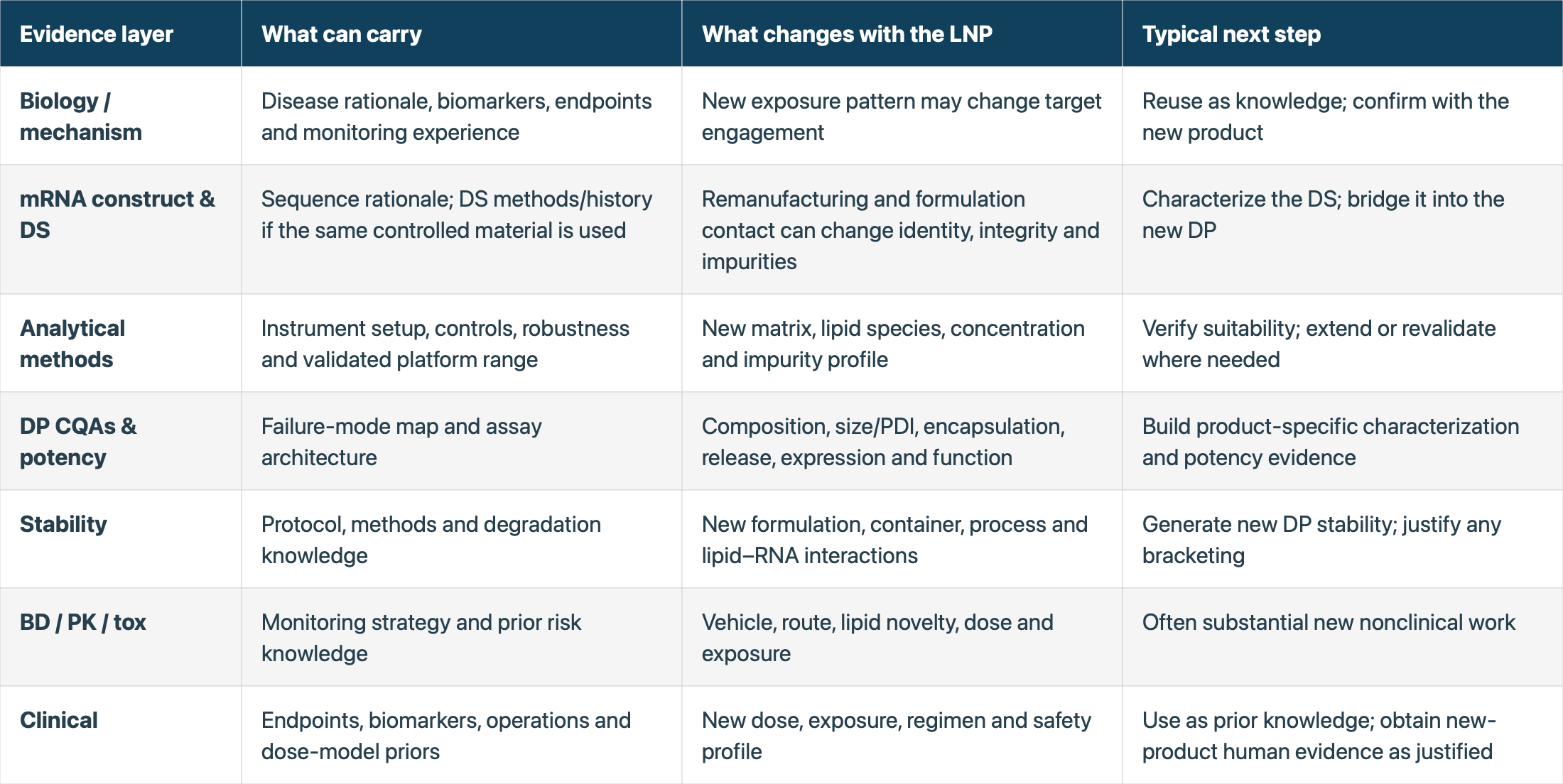
Two cases show the boundary
Arcturus: same therapeutic objective, changed lipids and formulation process
Arcturus describes LUNAR 2.0 as using improved lipids and an enhanced formulation process and plans to apply it in ARCT-2601 after clinical experience with ARCT-810. The company reports a large increase in NHP protein expression and says FDA provided favorable feedback and regulatory-path clarity. The public materials do not disclose the meeting minutes or identify which specific prior data, comparability analyses or protocol changes FDA accepted. [S6, S7]
ARCT-810 experience can inform biomarkers, clinical operations, liver-safety monitoring and repeat-dose questions. It does not establish ARCT-2601’s human dose, duration, tolerability or manufacturing comparability. The NHP expression result is a reason to test the new candidate—not a conversion factor from old product to new product.
ABO2203: public development history is not a comparability package
In RapidGene’s ABO2203 development biography, early patent examples and the later published method described different RNA-purification and LNP-development details. The public record supported a development narrative, but not a formal account of when each process changed, which lot entered toxicology, or how clinical material was bridged. [S8]
That distinction matters here. A company may know exactly how its old and new platform versions connect; an outside reader usually does not. “Same program” or “same payload” should never be used as a substitute for the actual change map, material genealogy and comparability evidence.
Build the bridge around the claim, not the old package
A practical platform submission or diligence package can be organized around five questions:
1. What exactly stayed fixed? Sequence, DS process, formulation components, site, equipment, route, dose concept and target tissue should be stated separately.
2. What conclusion is being carried forward? Name the claim: method validity, process range, stability, biodistribution, lipid safety, dose projection or clinical monitoring.
3. What new failure mode did the change introduce? For an LNP switch, consider lipid impurities and degradants, RNA damage, loading heterogeneity, altered cell exposure, innate activation and repeat-dose tolerability.
4. Which bridge is sensitive to that failure mode? Use a deliberate combination of analytical, functional, nonclinical and—where residual uncertainty remains—clinical evidence.
5. What remains unknown after the bridge? State the residual uncertainty and how it will be managed in the next stage instead of calling the package “platform-equivalent.”
FDA’s draft prior-knowledge guidance recommends explaining the source of platform knowledge, the similarity of product and process, the intended use of the knowledge and the justification for its applicability. It also allows a comparability study on one platform product to inform a similar change on another, but still expects product-specific evaluation of attributes such as potency when needed. [S2]
The most useful table for an early regulator discussion is therefore not a list of every prior study. It is a short map with six columns: prior evidence; invariant element; changed element; new risk; proposed bridge; and residual uncertainty. That forces the platform claim to become testable.
RapidGene take
Changing the LNP does not erase the value of everything learned before it. It also does not preserve the old product under a new name. The strongest carryover usually lies in knowledge of the disease, the payload, the process and assay failure modes, and in methods whose suitability has been demonstrated across a defined platform space.
The weakest carryover lies where the changed LNP is the primary driver: drug-product composition, delivery, potency, biodistribution, exposure, tolerability and clinical regimen. Those are not administrative gaps. They are the reason to change the formulation in the first place.
A durable platform is therefore not one that never repeats an experiment. It is one that can explain, before the next product is made, which evidence remains valid, which bridge will be decisive, and why the remaining work is smaller without being scientifically weaker.
References
S1 · Alliance for Regenerative Medicine, A Platform Framework for Gene Editing Drug Development — Industry framework; not binding guidance.
https://alliancerm.org/wp-content/uploads/2026/09/2026-ARM-Gene-Editing-Playbook.pdf
S2 · FDA, Leveraging Prior Knowledge in the Development of Human Gene Therapy Products Incorporating Genome Editing — Draft, non-binding, genome-editing focused.
https://www.fda.gov/regulatory-information/search-fda-guidance-documents/leveraging-prior-knowledge-development-human-gene-therapy-products-incorporating-genome-editing
S3 · FDA, Manufacturing Changes and Comparability for Human Cellular and Gene Therapy Products — Draft, non-binding.
https://www.fda.gov/regulatory-information/search-fda-guidance-documents/manufacturing-changes-and-comparability-human-cellular-and-gene-therapy-products
S4 · ICH Q5E, Comparability of Biotechnological/Biological Products Subject to Changes in Their Manufacturing Process — Final harmonised guideline.
https://www.ich.org/page/quality-guidelines
S5 · FDA, Potency Assurance for Cellular and Gene Therapy Products — Draft, non-binding.
https://www.fda.gov/regulatory-information/search-fda-guidance-documents/potency-assurance-cellular-and-gene-therapy-products
S6 · Arcturus Therapeutics, interim OTC results and LUNAR 2.0 announcement — Company disclosure.
https://ir.arcturusrx.com/news-releases/news-release-details/arcturus-therapeutics-announces-interim-otc-deficiency-phase-2
S7 · Arcturus Therapeutics presentation furnished with Form 8-K — Company presentation furnished to the SEC.
https://www.sec.gov/Archives/edgar/data/1768224/000119380526001277/e665798_ex99-1.htm
S8 · RapidGene, Abogen–Novartis: What Changes When the Body Makes the T Cell Engager? — Prior RapidGene analysis; related context, not independent primary evidence.
https://www.rapidgenebio.com/p/abogennovartis-what-changes-when